Arrest Records from Wichita’s Sedgwick County Adult Detention Facility can be accessed instantly through the official online portal, letting users perform an arrest records search by name, date, or agency. The system supports arrest record lookup, arrest history checks, and case number queries, while also displaying booking photos and charge details. Whether you need to verify an arrest date, locate a specific case number, or understand misdemeanor versus felony charges, the 24/7 searchable database provides reliable public arrest information.
When you need to find an arrest record online, start with the county’s searchable archive to request a certified copy or view the arrest report for free. The platform handles searches by location, arresting officer, and incident number, and clarifies whether records are sealed, expunged, or still active. Quick answers to common questions such as how to check if someone has been arrested or how to obtain a copy of an arrest report help users stay informed and confident in their search results.
How to Search Arrest Records
Arrest records from the Sedgwick County Adult Detention Facility can be searched through the county’s official inmate portal. A search can help locate a booking date, detention number, listed charge, arrest agency, and linked case number for a person booked into the adult facility. Residents can also inspect warrant logs for detailed public documentation. Its main purpose is to locate an available public booking entry, not to decide whether a person committed an alleged offense. Court dispositions, sealed orders, and current case status must be checked with the court or agency that holds them.
Official Search Portal: https://ssc.sedgwickcounty.org/InmateSearch/
Steps to Search
- Open the official inmate-search portal and enter the person’s legal name in the available name fields. Add a first name, middle name, or date of birth when those fields appear and the details are known.
- Use a second filter for arrest or booking date, arresting agency, booking number, case number, incident number, report number, or arresting officer when the portal offers that field.
- Review the returned names, dates, numbers, and photographs. Compare each plausible result with the identifiers supplied by the court, employer, or requesting party.
- Open a matching entry and review the arrest date, location, listed charges, agency, custody status, and associated case number. Treat every charge as an allegation unless a court record shows otherwise.
- Follow the portal’s report or copy instructions when a document is needed. If the screen does not state the fee or certification rules, contact the facility for a certified-copy request.
Arrest Record Details and Charges
An arrest report, jail booking, and court docket describe different parts of the same event. The inmate portal centers on detention bookings, while court dockets track filed cases, hearings, and decisions. That difference explains why one entry may show a charge, custody status, booking photograph, and linked case number without showing the outcome of the court case.
An arrest record may include the person’s name, date of birth, and booking number to help identify the correct entry. The arrest date and time show when the arrest occurred, while the arrest location, arresting agency, and officer information provide details about the incident. A report, incident, or case number may connect the entry to related agency or court records.
The charge description identifies the alleged offense, and the charge classification indicates whether it is listed as a misdemeanor or felony. The custody status shows whether the person is held, released, or transferred. A booking photograph, when available, may provide additional identification context. Always verify these details with official sources, as booking information may change and an arrest does not establish guilt.
Field names and available details can vary by entry. A missing photograph, absent arrest number, or incomplete status label does not prove that no arrest occurred. It may mean the field was not posted, the record belongs to another agency, or access to the material is limited by law or policy.
Misdemeanor and Felony Charges
Under Kansas law, a misdemeanor is punishable by a maximum term of less than one year, while a felony carries a maximum term of one year or more and may lead to confinement in state custody. The classification shown on a booking entry describes the charge entered at that stage. The charge citation, facts alleged in court, plea, and court decision determine the legal outcome.
A single arrest may produce several charges. Each charge can have its own number, description, and status. One charge may remain pending while another is dismissed, reduced, amended, or resolved through a plea. A portal entry can also reflect the original booking wording after the court has changed the case.
Charge status should be checked against the court docket when the final result matters. A pending charge shows that the case has not reached its last stage; it does not show that the person committed the alleged act. A dismissed charge means the court case ended without that charge resulting in a conviction, but the arrest history may still contain the booking and report.
Arrest Circumstances and Reports
The arrest report records details gathered when police or a sheriff’s officer detained someone, including the stated circumstances, suspected offense, and identifiers assigned during the arrest. A booking record then follows the intake into detention and can add the booking date, facility, charge listing, custody status, and photograph.
An arrest can occur with a warrant or without one, so the presence or absence of a warrant number in a booking entry needs context. The report number, incident number, arrest number, and case number can point to different records. Using the wrong identifier may produce no match or a result for a different event, which is why a name, date, and booking number should be compared together whenever possible.
Custody and Associated Court Records
Detention records and court records track separate events. The inmate portal follows a person’s entry into and release from the Sedgwick County Adult Detention Facility. A Kansas court docket follows charges filed after the arrest. Connecting the two records gives the clearest picture of what happened at the facility and what the court decided.
Booking Details and Facility Location
The booking date marks the time the person was processed into detention. It can differ from the arrest date because the arrest may occur at another place and the person must be transported before intake. A booking record may include the booking number, booking time, facility, listed charges, custody status, and later release details.
A custody status shows the person’s detention condition at the time represented by the entry. “Released” describes the end of that detention stay, not the end of the court case. A person can be released from jail while the prosecution continues, while a warrant remains, or while another case is pending. It can also mean the person was released after a bond, court order, recognizance, or other release action listed in the underlying record.
Warrant Status and Arrest Context
Three arrest situations can lead to the same type of booking entry. A police officer may arrest someone under a warrant issued by a judge. A judge may also issue a bench warrant when a person fails to appear as ordered. In other cases, a police officer may make an arrest without a warrant when probable cause and the governing legal requirements are present.
A booking entry does not prove that an active warrant still exists unless the portal expressly says so. It also does not show whether a warrant was later recalled, quashed, executed, or satisfied. If warrant status affects a decision, request the current record from the issuing court and confirm custody status with the sheriff’s office.
The presence of a warrant also does not prove guilt. A warrant is a judge’s order based on the filing presented at that time. The court case remains the proper source for later rulings, dismissal, plea, or conviction.
Court Case Filings and Disposition
The case number is the best link between a booking entry and a court file. A criminal case filed in Sedgwick County may appear in the Kansas district court system, where felony cases and certain misdemeanor cases are handled. City ordinance and other municipal matters may be handled by the appropriate municipal court. Cases heard in a U.S. district court appear in that court’s system rather than the state court docket.
Use the official Kansas Judicial Branch case search for district court records and the relevant municipal court clerk for city matters. Search by the exact case number first, then by party name if needed. The docket can show filed charges, court hearings, amended complaints, dismissed counts, plea agreements, sentences, and other case actions.
A disposition is the court’s closing action, not the same thing as a booking charge. A court file may show a dismissed case, reduced charges, a plea, a conviction, an acquittal, or another outcome. The inmate search can remain unchanged after some of those events because detention data and court data update through separate processes.
Booking Photos and Public File Copies
A booking photograph and a full arrest report serve different purposes. A photograph supports identity matching, while a report may contain the arrest circumstances, listed offense, involved agencies, and case identifiers. The public directory is a limited index and should not be treated as the complete file.
Booking Photos and Identity Checks
A booking photograph records the person’s appearance at the time of intake. It can be older than the current booking status, and the image may not appear for every entry. Removal from a public directory, agency posting rules, or a restriction on a particular record can also affect photo availability.
Photos can help narrow a search, but a shared name or an inaccurate label can place the wrong image beside a result. Compare the photograph with the booking number, date of birth, arrest date, charge, and agency. If those details conflict, rely on written identifiers and confirmation from the agency rather than visual similarity alone.
Public Directories and Redacted File Content
A public inmate directory may show a name, booking number, booking date, charge description, custody status, and photograph. You can also access current bookings public records to review official records. A full arrest report can contain more detail, including investigative notes, statements, property records, linked agencies, and information supplied by the person arrested.
Some material may be removed from a public copy when a law protects it from release or agency policy limits distribution. Redaction means the document remains, but a protected portion is hidden. A public directory can also omit an entire report even though the agency holds it.
The Kansas Open Records Act, K.S.A. 84-1-101 et seq., provides a request process for records held by public agencies, subject to statutory exceptions. A request should identify the record, the person, the date or case number, and the agency holding it. Court files, sealed records, juvenile records, and expunged records follow separate court or juvenile rules, so the inmate portal cannot remove those restrictions.
Juvenile Records and Active File Restrictions
The Sedgwick County Adult Detention Facility holds adult detention entries. A search of this portal is not a juvenile record search. Juvenile matters in Kansas are handled through the juvenile court system and the agencies connected with those cases, and their access rules differ from those for adult records. A missing adult booking entry cannot establish whether a person has a juvenile record.
A record connected with a pending investigation or court case may also have parts that remain unavailable until the matter closes or a court changes the status. A label such as “active” does not mean every related document can be viewed. The agency or issuing court can confirm which material is public and which part is restricted.
Record Status, Missing Results, and Corrections
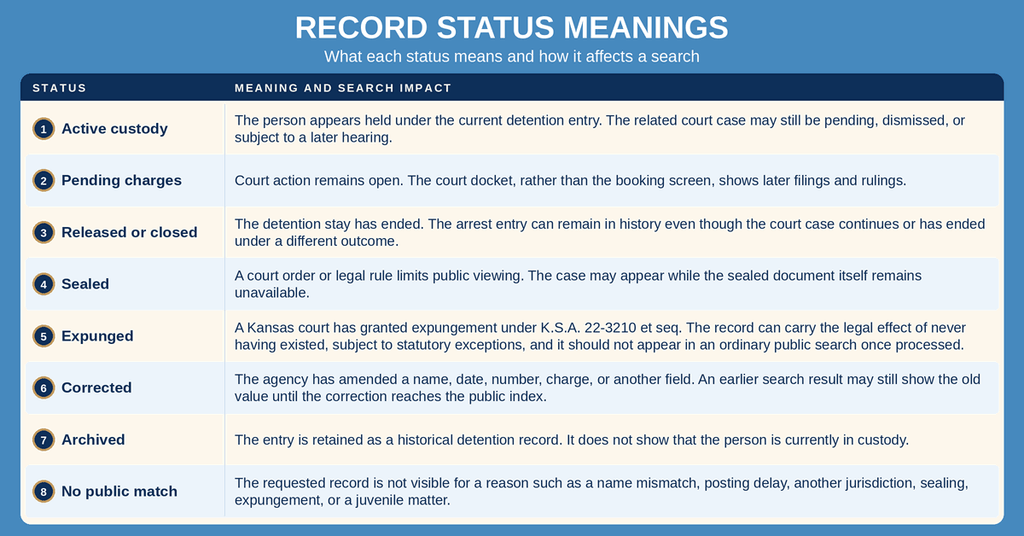
Status labels help explain what a result represents, but they do not all describe the same stage. A person may have a closed detention record and a pending court case, or an active booking tied to charges that were later dismissed. Reading the booking, court, and case status together prevents a simple online label from creating a false conclusion.
Update Delays and Missing Records
Search indexes and source databases do not update at the same moment. A booking can appear after the person has entered custody, released, or moved to another facility. Photo posting, charge changes, name corrections, and transfers can take extra time. A missing result may also result from a middle name, suffix, legal name change, or spelling difference that the portal does not match.
Records from other Kansas counties usually come from separate systems. A Sedgwick County search does not cover every arrest in Kansas or the United States. A person may also have been booked under a different legal name, or the requested entry may be outside the period retained in the public directory. No match is a search result, not proof that no arrest occurred.
Sealed, Expunged, Corrected, and Archived Records
Correcting a Missing or Incorrect Entry
Start with the most exact identifiers available, such as the booking number or case number, and check them against the agency and date. If the record names the wrong person, gives an incorrect arrest date, or contains another wrong field, send the agency the exact identifiers, describe the conflict, and request a review or correction. Keep the original entry number so staff can locate the source record.
An agency correction may amend an administrative field, add a note, explain a different legal name, or confirm that the entry belongs to another person. The public search screen may not change after a correction. For a charge, plea, dismissal, or case outcome, request the court docket instead of asking the jail to change a court entry.
For a sealed or expunged matter, contact the court that issued the order or handled the expungement request. A request to the detention facility cannot remove a court seal or reverse an expungement order. For a report that exists but is not posted, make a public records request to the agency holding it and ask for the legal basis of any withheld material.
Arrest, Charge, and Conviction Are Different
An arrest means that police officers or a sheriff’s officer took someone into custody under legal authority. It does not mean that a court found the person guilty of every listed charge. Probable cause is the legal basis used for many arrests, and it is a lower standard than the proof needed for a conviction.
Booking is an administrative step that creates a detention record. A booking entry can show when and where someone was processed, which charge was entered at intake, and whether a photograph was taken. The entry records agency activity; it does not replace the pleadings, evidence, testimony, and rulings in the court file.
A charge is a formal accusation made through the court process. A person can be charged with one or several offenses, and the charges can change during the case. A conviction occurs only after the legal process reaches a guilty finding, such as a plea or a court decision after trial.
Until a court finds guilt beyond a reasonable doubt, the person is presumed innocent. A public booking entry, arrest report, or booking photograph should never be presented as proof of guilt. Sealing limits public viewing without erasing the underlying record, while a granted expungement can change the record’s legal effect. The court order controls either status.
Requesting an Arrest Record Copy
The county’s inmate-search service provides free viewing of available reports, but a normal online view is not the same as a certified copy. A certified copy carries formal authentication for use when a receiving party asks for proof that the county issued the document. Court records and agency reports also follow separate copy procedures.
Before requesting a copy, decide whether a saved portal view is enough. A printout or downloaded file without a certification statement is an ordinary copy unless the agency says otherwise. If a certified document is required, ask the records custodian to confirm that the requested arrest report can be certified and which booking number or case number identifies it.
Include the person’s legal name, date of birth, arrest or booking date, booking number, case number, and arresting agency when those details are known. Ask for the current fee and accepted payment method before sending payment. The office should also confirm any identification requirement, delivery option, and expected preparation time, since those terms can change.
A public records request does not remove a court seal, reverse an expungement, or make juvenile material public. It applies to records held by the named public agency and remains subject to legal exceptions. A rejected request may require review by the agency’s records custodian or another remedy listed in the response.
Contact Information
Use the following contact details for a specific booking record, certified-copy request, correction request, or search problem involving a record held by the facility.
- Address: Sedgwick County Adult Detention Facility 141 W. Elm Wichita, KS 67203
- Phone: (316) 660-5245
- Office hours: Open 24 hours a day, 7 days a week (24/7)
Frequently Asked Questions
This list answers common questions about finding and using arrest records for the Sedgwick County Adult Detention Facility.
How can I search arrest records in Sedgwick County?
Visit the official inmate portal at https://ssc.sedgwickcounty.org/InmateSearch/. Enter the person’s name, booking number, or case number into the search fields. The system returns booking date, detention number, listed charges, arresting agency, and linked case details. Results are public and update as new entries are added. If the name yields no matches, try alternative spellings or search by date range. For assistance, call the facility at (316) 660-5245 during any hour.
What information appears in an online arrest lookup?
An online arrest lookup shows the booking date, arrest time, location, and facility where the person is held. It lists the arrest number, case number, arresting agency, and specific charges. You can also see the custody status and any scheduled court dates. Mugshots may appear if they are part of the public record. The portal does not provide legal judgments or sealed case details, only the booking information that is publicly released.
Can I get a copy of a sealed arrest record?
Sealed arrest records are not available through the public portal. To request a sealed file, you must petition the court that issued the sealing order. The court may grant access only to the person named in the record, their attorney, or an authorized agency. If the court denies the request, no copy can be provided. For unsealed records, you can download a certified copy directly from the inmate search site or request it by mail using the county clerk’s form.
How do I find arrest history by name?
Enter the full or partial name into the Sedgwick County inmate search field. The system matches any bookings that contain the entered characters. Review each result for the correct individual by checking birth dates or middle initials when available. If multiple entries appear, use additional filters such as date range or charge type to narrow results. The portal updates daily, so recent arrests will appear shortly after booking.
What phone number reaches Sedgwick detention office?
Call (316) 660-5245 to speak with staff at the Sedgwick County Adult Detention Facility. The line is open 24 hours a day, seven days a week. Representatives can confirm an inmate’s status, provide booking details, and explain how to access public arrest records online. For non‑urgent inquiries, you may also use the online portal to retrieve information instantly.